Tuesday, 29 April 2014

Ça, c'est ma journée!

In Gr. 3 and 4 this week, we are learning how to tell time in French to the hour so we can use a timeline to describe a schedule of activities.


 We're cutting and pasting pictures of activities onto a timeline.


In our Gr. 4, 5 and 6 hockey unit, we are continuing to work with hockey-related vocabulary. We've started making predictions about who will win "La Coupe Stanley" this year.

Stay tuned for photos from Grades 7 and 8, who will be making something sweet and special to eat this week as part of French club and our Foods unit!

Our "Question of the Week" is "Qu'est-ce que tu vois?".  We will describe briefly what we see in the classroom in our answer.

À bientôt,

Mme Christensen


Monday, 21 April 2014

Joyeuses Pâques!


Joyeuses Pâques! I hope you had a blessed Easter!

This week, the Gr. 3/4 class will be continuing to learn vocabulary and structures that will help them describe their daily routines in our unit called "Ça, c'est ma journée".  The verbs that we have learned so far lend themselves well to a game of charades or "Simon Says".  Here are a couple examples of some of the structures we are learning:

Elle joue de la guitare à 4h00.


Il fait du karaté à 6h00.


The Gr. 4/5 as well as 5/6 class have started a unit called "Mon Héros".  This week we will be looking forward to learning a little bit more about a Montreal Canadien hockey star as well as some hockey vocabulary!

The Gr. 7/8 class began a learning journal to record new vocabulary and structures related to our foods unit.  By the end of this unit, each student will be involved in a presentation of a favorite recipe to the class, en français, bien sûr!

We will be reviewing last week's "Question of the Week" for additional practice.

À la prochaine,

Mme Christensen


Saturday, 12 April 2014

French Camp!

L' Université de Saint-Boniface is once again offering "Tu parles!",  a week-long summer daycamp for 7-12 year old children.  This program  "is designed to help your children acquire French speaking skills that can be used inside and outside the classroom" and "offers a healthy mix of classroom time, field trips, outdoor fun and hands-on activities such as arts, crafts, music and games."

There is also an advanced-level camp for 13- to 15-year-olds during Week 7 if registration is sufficient.

For more program information and the camp registration form, click here. 


Bon appétit!


We kicked off our new unit in 7/8 with a sushi-preparation demonstration.  By the end of our unit, each student will demonstrate the preparation of a favorite dish en français!  We reviewed strategies to help us understand a sushi recipe in French.  We discussed:

  • making predictions
  • skimming or scanning the text quickly to get a general understanding of the material
  • observing illustrations and photos
  • making connections with previous knowledge
  • searching for mots amis (word friends--French words that are similar to English words)
  • searching for familiar words
  • observing titles and sub-titles, 
to name a few!

In Grades 3/4, we celebrated two birthdays in the classroom this week.  Each student prepared lovely cards full of kind sentiments, en français!  Creating birthday cards gives students an authentic opportunity to communicate, to practice the use of adjectives and to explore new vocabulary.

Sports is "on the menu" in 4/5 and in 5/6, shortly.

Our "Question of the Week" will be "Où habites-tu?" (Where do you live?") and its response, "J'habite à Winnipeg."

À bientôt,

Mme Christensen


Monday, 31 March 2014

French club: Pâte à choux

We ended our last week before Spring Break on a light and refreshing note!  Gr. 7 and 8 students assembled (and savoured) pâte à choux with crème anglaise, a custard filling.  The recipe is below.


Pâte à choux recipe:

1 cup water
1/2 cup butter
1 cup all-purpose flour
4 eggs, beaten
Cream filling (below) (Whipped cream can also be used.)
Powdered sugar 

Heat oven to 400. Heat water and butter to al rolling boil in heavy saucepan.  Stir in flour and reduce heat.  Stir vigorously until mixture forms a ball; remove from heat.  Beat in eggs, all at once.  Continue beating until smooth.  Drop dough by heaping teaspoons onto ungreased cookie sheet.  Bake 35-40 minutes or until puffed and golden brown.  Cool.  Cut off top of each puff and fill with cream filling.  Dust with powdered sugar and serve.

Crème anglaise

1/3 cup sugar
2 tbsp corn starch
1/8 tsp salt
2 cups milk
2 egg yolks, beaten
2 tbsp butter
2 tsp vanilla

Mix sugar, corn starch and salt in heavy saucepan.  Gradually stir in milk.  Cook over medium heat, stirring constantly until mixture thickens and boils.  Boil and stir one minute.  Gradually stir at least half of the boiled mixture into the egg yolks.  Stir egg yolk mixture into saucepan. Boil and stir one minute; remove from heat.  Stir in margarine and vanilla; cool.  Use to fill pâte à choux.

This past week was Country Week and students enjoyed an introduction to the Twi language, one of the main languages of Ghana.  Our learning of a bit of Twi led us to explore the following:

  • What kinds of basic words or phrases should we be familiar with if we are travelling to a country whose language we do not know?
  • What strategies will help us learn those phrases as efficiently as possible?
Perhaps this Spring Break will take you to some new places to explore!  I wish you a happy, safe and fun vacation.

Bonnes vacances et à bienôt,

Mme Christensen


Sunday, 23 March 2014

Fun with "les diseurs"


Each class has been reviewing the questions and answers learned this term using 
"les diseurs".


We practiced in preparation for our student-led conferences held this past week.  Thank you to all the parents who came to celebrate their child's learning!

This week, all classes will be studying the country of Ghana as part of our "Country Week" celebrations. "Another way to validate the experience of second language learning is to expose students to other languages, and to encourage them to learn a third language." (Florence Girouard and Sandra Drzysteck, Bureau de l'éducation française).  Some of the same strategies that we have used to learn French will be put to use as we learn a bit of the Ghanaian language this week!

You can read more of the article written by Florence Girouard and Sandra Drzysteck at this link  The Added Value of Learning Another Language .

À bientôt!

Mme Christensen

Sunday, 16 March 2014

Haiku en français

This past week we have been creating haiku poetry using what we have learned this term.  Students wrote poems on a variety of subjects, such as winter, family members, Festival du Voyageur and pets.


We will continue to review as we prepare for student-led conferences this week!

À bientôt!

Mme Christensen

Sunday, 9 March 2014

"Mini-professeur"

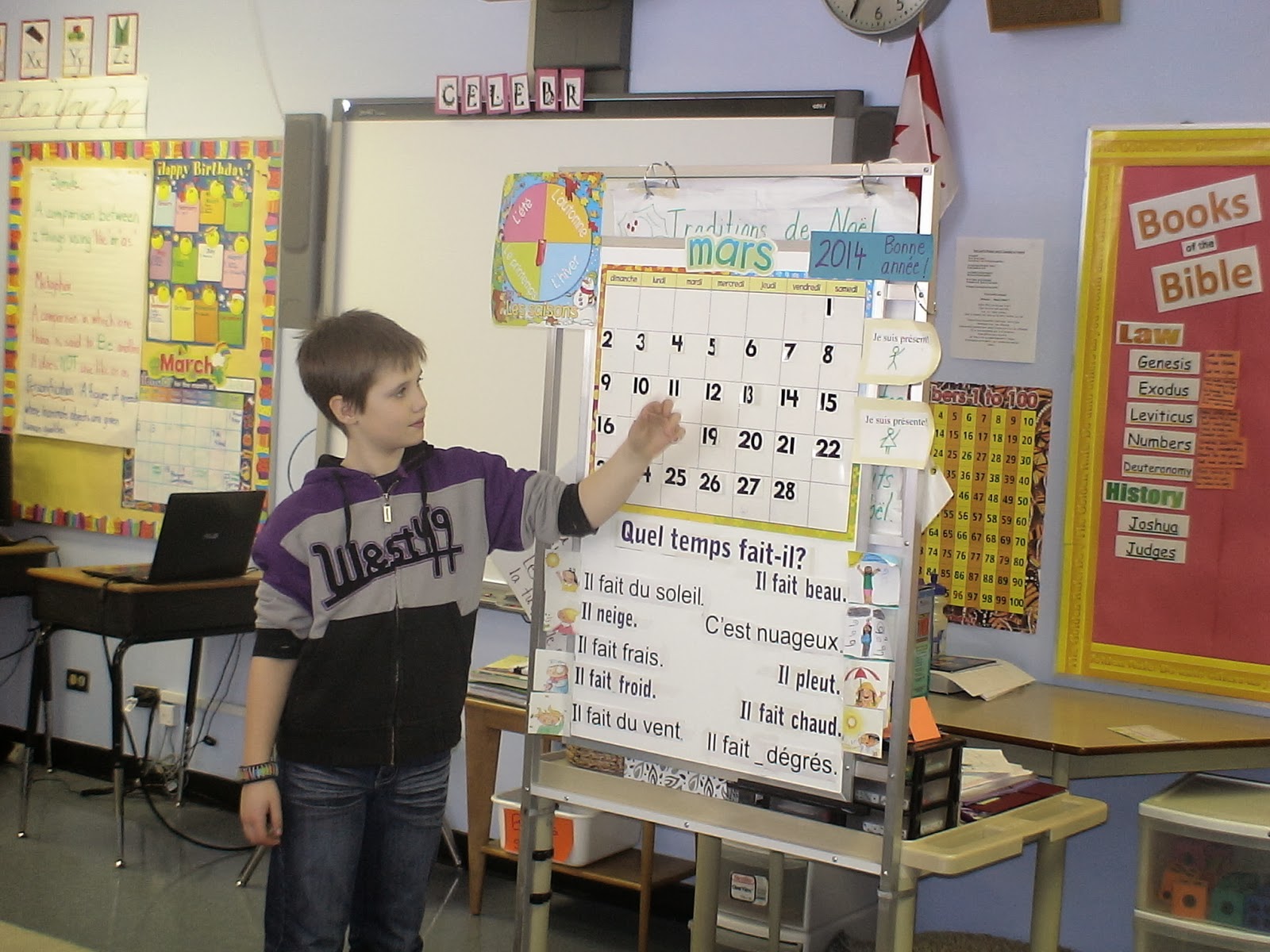
Part of our daily routine at the beginning of each class is the "mini-professeur". Each students has a turn being the "mini-professeur", questioning the class on the date, weather and season.


The "mini-professeur" asks the class:

  • Quelle est la date aujourd'hui?
  • Quel temps fait-il aujourd'hui?
  • Quelle est la saison?
This past week we discussed what we have learned about French culture.  Each class filled a "sac culturel" with observations of French culture, with many ideas originating from our Christmas and Festival du Voyageur units.

This week we will continue to review our previous "Questions of the Week".  We will also be getting creative with some poetry.  Stay posted!

À bientôt!

Mme Christensen